
The Real Reason Hospitality Businesses Struggle With Cash Flow

Written by Jennifer Lowe

The revenue of certain businesses rises and falls with the seasons. Small hospitality businesses in the UK are a prime example, with sales, revenue and cash flow shaped by holidays, local events, tourism and consumer confidence. December, in particular, brings a surge in demand, with restaurants filling up, pubs getting busier and hotels welcoming more guests. While this can be the strongest trading period of the year, it also comes with higher operating costs, including increased staffing costs and larger stock orders, alongside greater tax liabilities. Many of these costs remain long after the festive rush is over, when sales begin to slow.
This seasonal trading creates a mismatch between when money comes into the business and when it needs to go out. Understanding that cycle is fundamental to planning ahead, managing quieter periods more effectively and choosing funding that fits the way a business actually trades. This guide explores how that seasonal rhythm plays out across the year and what businesses can do to manage it more effectively.
Hospitality does not trade in a straight line
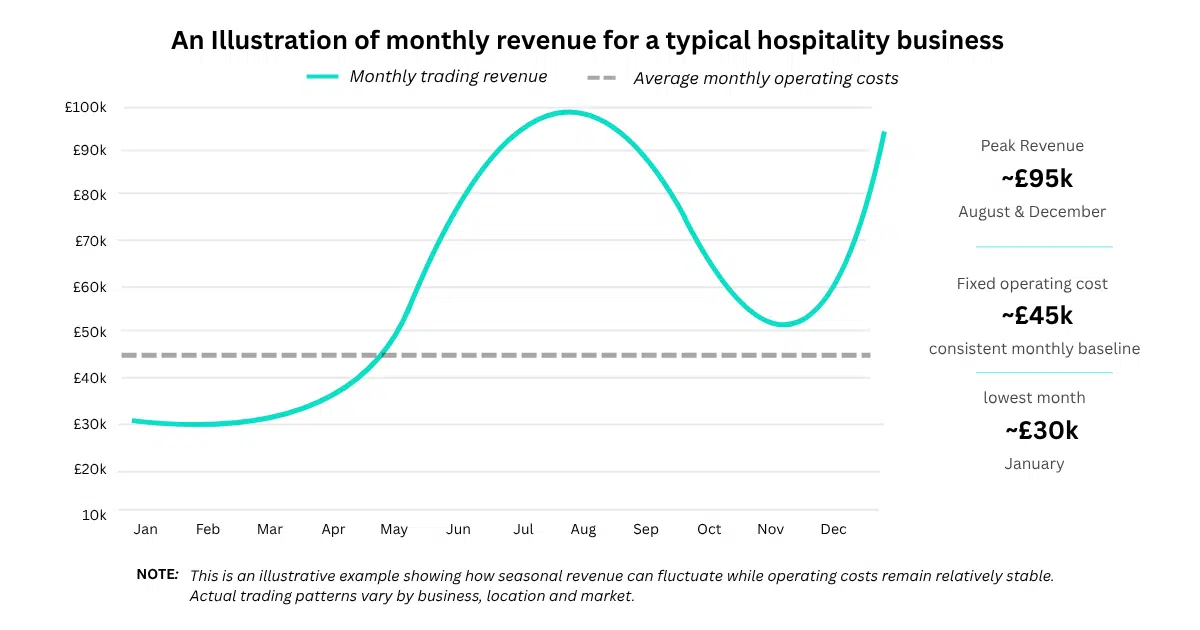
Sales figures for most hospitality businesses are rarely consistent over the course of a year, if ever. The demand for businesses in this sector naturally rises and falls as the year progresses, creating periods of strong revenue followed by quieter months. The scale of those fluctuations varies from year to year, but the pattern remains consistent. Recent figures from the NIQ RSM Hospitality Business Tracker illustrate this well, with like-for-like sales rising by 2.9% in December 2025 before slowing significantly in January 2026 as festive demand faded.
The challenge is that while revenue fluctuates, many of the costs of running a hospitality business do not. Rent, business rates, insurance, utilities, software subscriptions, equipment leases, licensing fees and wages all remain payable regardless of how busy a venue is. Those costs have also continued to increase, with successive fiscal and policy changes adding further pressure through higher wage bills, increased employer National Insurance contributions and changes to business rates.
Together, these factors make cash flow such a persistent challenge for hospitality businesses. Revenue arrives in peaks and troughs, while expenses continue on a much more predictable schedule. The result is a reality where cash doesn’t always come into the business when it’s needed most.
What a typical year of hospitality cash flow looks like
Revenue and expenses for hospitality businesses rarely peak at the same time, which means today’s busy period is often funding tomorrow’s obligations. Looking at a typical trading year shows why cash flow pressure returns so consistently across the sector.
January
The festive rush is over and customer spending falls sharply, but many of the costs of December are only just becoming due. Supplier invoices arrive, Christmas borrowing may need repaying and, depending on the VAT quarter, a payment may also fall due. Cash reserves that looked healthy in December can disappear surprisingly quickly.
February
Valentine’s Day provides a welcome boost for many restaurants, but it’s rarely enough to offset the slower start to the year. For many businesses, the focus remains on rebuilding cash reserves rather than generating growth.
March and April
Mother’s Day, Easter and warmer weather bring customers back through the door, and cash flow begins to recover. At the same time, businesses continue to absorb rising operating costs, including higher staffing expenses and other seasonal outgoings.
May and June
As wedding season, tourism and outdoor trading gather pace, operators begin preparing for the busy summer months. Stock levels increase, seasonal staff are recruited and spending rises before the strongest trading weeks have fully arrived.
July and August
These are often the busiest months of the year, particularly for hotels, coastal venues and businesses with outdoor space. But higher sales are matched by higher costs, including additional staff, larger stock purchases, overtime and increased energy use. A busy summer doesn’t always translate into stronger cash flow.
September
Trade steadies as routines return after the summer holidays. For many operators, attention begins to shift towards planning for the final quarter and the festive season.
October and November
Cash starts leaving the business well before Christmas arrives. Stock is ordered, marketing campaigns launch, deposits are paid and seasonal staff are recruited, all in preparation for the busiest period of the year.
December
Revenue reaches its peak, but so do financial commitments. Temporary staffing, larger stock orders, seasonal bonuses and extended opening hours all demand cash while trading is at its busiest. Much of December’s income is already committed before January begins.
Hospitality cash flow is circular rather than linear. Each season helps finance the next, meaning today’s busy period is often paying for tomorrow’s obligations. Understanding that rhythm is the first step towards managing cash flow more effectively.
Why a busy venue can still run short of cash
A busy pub, restaurant or hotel doesn’t automatically translate into healthy cash flow. In fact, it can sometimes mean the very opposite. As customer demand increases, businesses also have to match that growth with higher operating costs. Business owners need to buy more stock, schedule more staff, pay higher card processing fees and build up larger VAT liabilities. So, while revenue rises, so do the costs required to generate it. This is one of the main reasons a strong trading period doesn’t always mean there’s more money in the bank.
For instance, a restaurant could see a 35% increase in sales over the summer yet experience only a modest improvement in available cash once suppliers, payroll and other operating costs have been paid. The question is no longer how much revenue the restaurant generated, but how much cash is actually left to meet its day-to-day financial obligations. A hospitality business can therefore enjoy strong trading and still struggle to pay its bills if much of that revenue has already been committed elsewhere.
Timing also adds to this pressure. Suppliers would typically need to be paid before the stock they’ve delivered has been sold, wages fall due regardless of weekly trading performance, loan repayments may still need to be met, and VAT payments can arrive just as seasonal demand begins to slow. For many hospitality businesses, the VAT return for the quarter ending 31 December is due by 7 February, placing one of the year’s largest tax payments in the middle of one of its quietest trading periods. Obligations like these can place significant pressure on working capital, even when the business is trading well.
Fixed monthly repayments can make things worse
Business loans are commonplace in the UK SME landscape. They are a common way for owners and operators to fund business growth, invest in new opportunities and prepare for periods of higher demand. For instance, if a restaurant owner expects a spike in demand in two months’ time, it’s good business practice to start recruiting staff and stocking up in advance, even if that preparation has to be financed with a loan. When sales increase, all that’s left is to repay the borrowing. For many businesses, that’s a perfectly sensible approach. For hospitality businesses, however, fixed loan repayments can become much harder to manage.
Traditional business loans typically require fixed repayments, regardless of how a business’s revenue changes throughout the year. For hospitality businesses, where income can fluctuate significantly between peak and quieter trading periods, those fixed repayments can put greater pressure on cash flow during slower months.
Consider a venue with a fixed monthly repayment of £2,000:
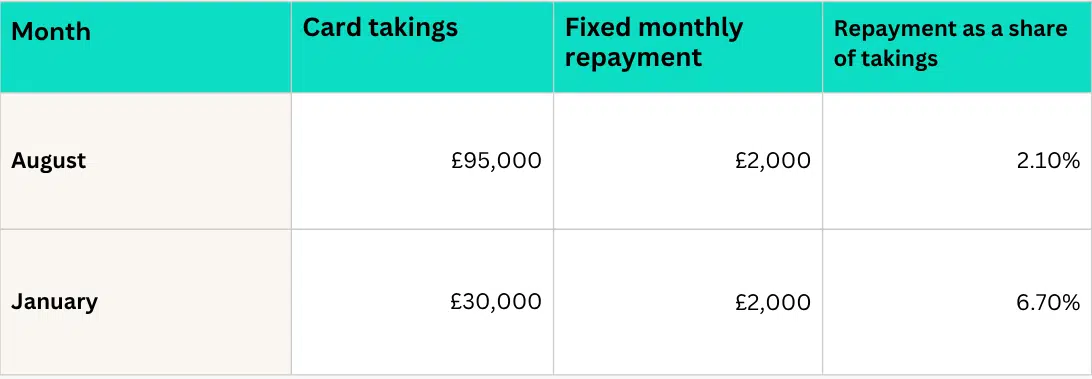
The repayment hasn’t changed, but its impact has. During a busy August, £2,000 represents a relatively small proportion of monthly takings. In January, the same repayment takes a much larger share of revenue, at precisely the time VAT, supplier invoices, wages and other fixed costs are competing for the same cash.
Since the repayment schedule stays the same regardless of whether the business is trading at its busiest or its quietest, there’s a clear reduction in financial flexibility when it’s needed most.
Why revenue-linked repayments fit the hospitality cycle
If hospitality’s biggest cash flow challenge is that revenue fluctuates throughout the year, it makes sense to consider funding that accommodates those fluctuations. That’s the major idea behind revenue-based finance. Revenue-based finance products, including merchant cash advances, provide funding with repayments linked to a business’s sales. Instead of making fixed monthly repayments, the funding is paid back as an agreed percentage of card sales.
Repayments naturally increase during busy trading periods because revenue is higher. When trade slows, repayments reduce automatically. Rather than working to a fixed repayment schedule, the funding adjusts to the business’s actual trading performance. For hospitality businesses with seasonal income, this flexibility can help reduce pressure during quieter months without preventing faster repayment when cash flow is stronger. It doesn’t make finance cheaper, nor is it the right solution for every business. However, it can help address one of the industry’s most common cash flow challenges: meeting fixed repayments when revenue is at its lowest.
Our own funding data reflects this demand for greater flexibility. Hospitality businesses have been among the most frequent applicants for revenue-based finance, with demand continuing to grow as more businesses seek funding that better aligns with their trading performance.
Staying ahead of seasonal cash flow
Seasonality isn’t a problem that hospitality businesses can eliminate. It’s part of the industry’s commercial reality. Demand rises and falls throughout the year, while rent, wages, supplier payments, tax obligations and other operating costs continue on their own schedule. The businesses that navigate these cycles most successfully aren’t necessarily those with the busiest trading periods, but those that plan ahead for the quieter ones.
That doesn’t mean every business needs funding. Many operators manage seasonal fluctuations through careful cash flow forecasting, stronger cash reserves and disciplined cost management. But when additional finance is needed, choosing a funding solution that reflects how the business actually trades can help reduce pressure during quieter periods. For businesses with seasonal revenue, flexible funding can be a better fit than fixed monthly repayments.
Ultimately, hospitality cash flow is less about reacting to slow months than preparing for them. Understanding the rhythm of the business, planning for predictable cash flow pressures and choosing the right funding when it’s needed can help hospitality businesses stay resilient throughout the year.