
How to Spot a Trustworthy Unsecured Lender

Written by Benjamin Horton

Unsecured business finance has become one of the most important funding routes for UK small businesses, particularly in sectors susceptible to cash flow pressure. This sits within unprecedented growth in the wider “non-traditional” lending market, driven by the fact that this type of financing suits certain businesses better than the traditional high-street route. Unfortunately, that growth has also led to varying standards around pricing, transparency, and customer treatment. Not every unsecured lender deserves the trust that comes with a broker introduction, or a business signing on to their products.
This guide explores how to tell which ones are worth that trust, across regulation, pricing, underwriting, post-funding conduct, and how a lender treats the partners who refer business to them.
Understanding unsecured business finance
An unsecured business loan is funding that isn’t tied to any specific asset. The lender has no claim on a building, a piece of equipment, or stock it can seize if the business can’t repay. That’s what makes it quicker and easier to access than traditional lending which is what matters most when working capital is needed fast.
The unsecured market runs from fixed-repayment term loans to revenue-based products like merchant cash advances. An MCA works differently from a standard loan: instead of fixed monthly payments, repayment is a small percentage of daily card takings, and continues until the agreed total is cleared. Because repayments move with revenue, it tends to suit businesses whose income is seasonal or uneven, those that need funding faster than a bank can move, or those trading well without the credit history a high-street lender expects. It can cost more than secured lending, as the provider takes on more risk without collateral; but the total is fixed and agreed before anything is signed.
Note: Some unsecured finance products fall under FCA regulation, while others, including many business-to-business merchant cash advances, do not. Businesses should always understand what regulatory protections apply before proceeding.
Check 1: Verify who you’re dealing with
The first check is the simplest, and often the most important: does the lender actually exist, and are they who they say they are? This usually takes around three minutes and can filter out a lot of bad actors early. Start with Companies House. Check the legal name, registered office, filing history, and current and former directors.
A credible lender will typically show:
- Several years of consistent, up-to-date filings
- A stable registered address with minimal unexplained changes
- No signs of a “phoenix” pattern, where the same directors repeatedly shut down short-lived entities and reappear under new company names within a short period
Be cautious of vague regulatory language, particularly claims like “FCA-regulated” or “fully regulated” that aren’t clearly tied to the actual lending entity. Any regulatory claim can be verified on the FCA register by searching the firm name or reference number. Beyond regulation, voluntary trade body membership is a meaningful signal; look for BMCAA membership, NACFB affiliation, and FSB membership as markers that a lender holds itself to wider industry standards.
Check 2: Transparency on cost and terms
Unsecured finance is typically presented with a clear, all-inclusive cost that is agreed upfront before funding is released. That means that the total cost of the facility is known from the start, there’s no APR, no compounding interest and no fixed monthly repayment structure.
In short, a trustworthy unsecured lender will:
- Be clear and upfront about the full cost before approval, not after
- Set out all fees in advance, with no hidden arrangement, admin, or documentation charges introduced later
- Keep the agreed cost structure consistent from the initial offer through to the final agreement
A simple test: can the total cost be understood in advance, without needing to interpret fluctuating interest rates or complex repayment schedules? If not, that’s worth pressing on before anything is signed.
Check 3: Responsible underwriting even when it’s unsecured
While every unsecured loan lender brings their own nuance to the eligibility process, one pattern holds true among reputable ones: they look beyond credit scores and focus on the full picture, examining how the business actually trades, using cash flow data rather than credit conditions alone. Drawing on this data alongside soft credit checks allows lenders to make faster decisions and can make funding more accessible than traditional bank applications..
While this means more businesses can get approved, a genuinely trustworthy lender will still decline when a deal doesn’t fit, whether the business isn’t the right profile, or the data simply doesn’t support it.
That’s why a “we approve 100% of applications” claim shouldn’t be read as generosity or borrower-friendliness. It should be read as a warning sign of flawed underwriting, because lenders who fund everyone end up funding a lot of deals that shouldn’t have been funded, and the borrower ends up paying for it, sometimes literally, sometimes through stacked debt and aggressive collections. Most responsible unsecured lenders operate with approval rates somewhere between 85-96%.
Check 4: What happens after the money lands
Post-funding conduct is where trustworthy lenders distinguish themselves, and where the less reliable ones tend to go quiet. The practical way to assess it is through the lender’s structural setup and their track record with existing clients. A trustworthy lender assigns a named relationship manager from day one, publishes a clear complaints procedure even for unregulated products, and runs a documented renewal process. A lender that should be trusted has a dedicated relationship manager in place from the start of the application and gives every repeat client a consistent point of contact at renewal. Renewal teams provide this kind of continuity that separates a lender that retains customers from one that churns through them.
Reviews fill in the rest of the picture, provided they’re read critically. But the most telling signal is how the lender responds to negative feedback. A quick, accountable response to a complaint reveals more about a lender’s character than a high star rating does.
Renewal and retention rates are the clearest indicator of all. Businesses return to lenders that treated them well. Therefore, a lender with a strong base of returning clients is one whose previous SME borrowers were satisfied enough to come back.
Check 5: How a lender treats the people who refer business to them
The lender-introducer relationship reveals the same character a lender brings to its merchants. First, commission should be paid by the lender, never the borrower. Terms should be clear and written, payment on the initial deal, plus a share of renewals where applicable. A lender willing to pay on renewals expects to retain the client, which means they intend to treat that client well.
On the operational side, look for:
- A working partner portal where deals are submitted (and tracked)
- Real-time deal status, so brokers aren’t chasing for updates
- Clear submission criteria, so brokers know what fits before they introduce
- Decline reasons in writing, so brokers can learn rather than guess
- Responsive support when a deal needs escalating
Warning signs that should end the conversation
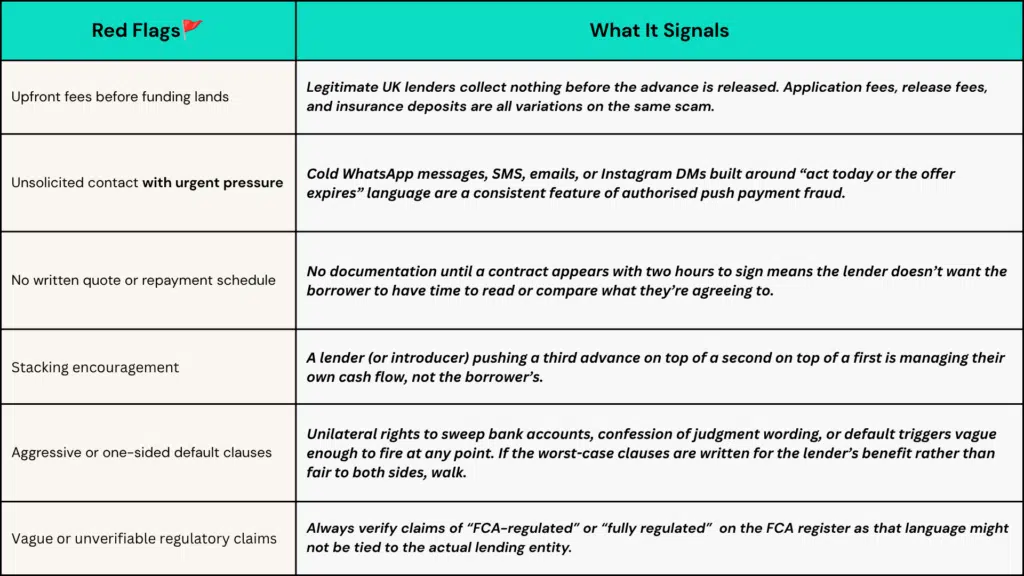
Before placing any client, it’s worth running a quick check against the most common signs of a lender that shouldn’t be trusted. The table below sets out what to look for and what each signal actually means in practice.
A quick checklist
Five questions to run through before placing any client with an unsecured lender:
- Are they verifiable on Companies House, listed on the FCA register where applicable, and affiliated with recognised trade bodies?
- Is the cost one all-inclusive number, agreed upfront, that doesn’t drift between offer and paperwork?
- Do they decline when a deal genuinely doesn’t fit?
- Do they look after clients after funding, with named contacts, a real complaints procedure, and a documented renewal process?
- Do they treat introducers as long-term commercial partners, not one-off lead sources?
A yes to all five is rarer in the UK unsecured market than it should be. 365 Finance was built to be one of them. If you’d like to talk about working together, start here.
365 Finance provides revenue-based unsecured funding for businesses processing card payments; from hospitality and retail to salons, trades, and service businesses. Because repayments are linked to card sales rather than fixed to a calendar, the structure adjusts to how the business actually trades, which matters most when cash flow is under pressure. For brokers looking to place clients with a lender built around transparency, responsible underwriting, and long-term relationships, explore what working with 365 Finance looks like.